
Teams usually feel DevOps pressure when delivery slows, incidents repeat, cloud bills rise, or production knowledge sits with one or two people. The problem rarely gets fixed by renaming someone “DevOps” or buying another tool. DevOps works when it becomes an operating model for how software moves to production and how the team keeps it healthy after release.
The practical question is simple: can your team ship changes safely, recover quickly, control infrastructure, pass audits, and operate production without a single point of failure? The answer should guide whether you build an internal DevOps team, use DevOps as a Service, or combine both.
Start with the operating model, not the org chart
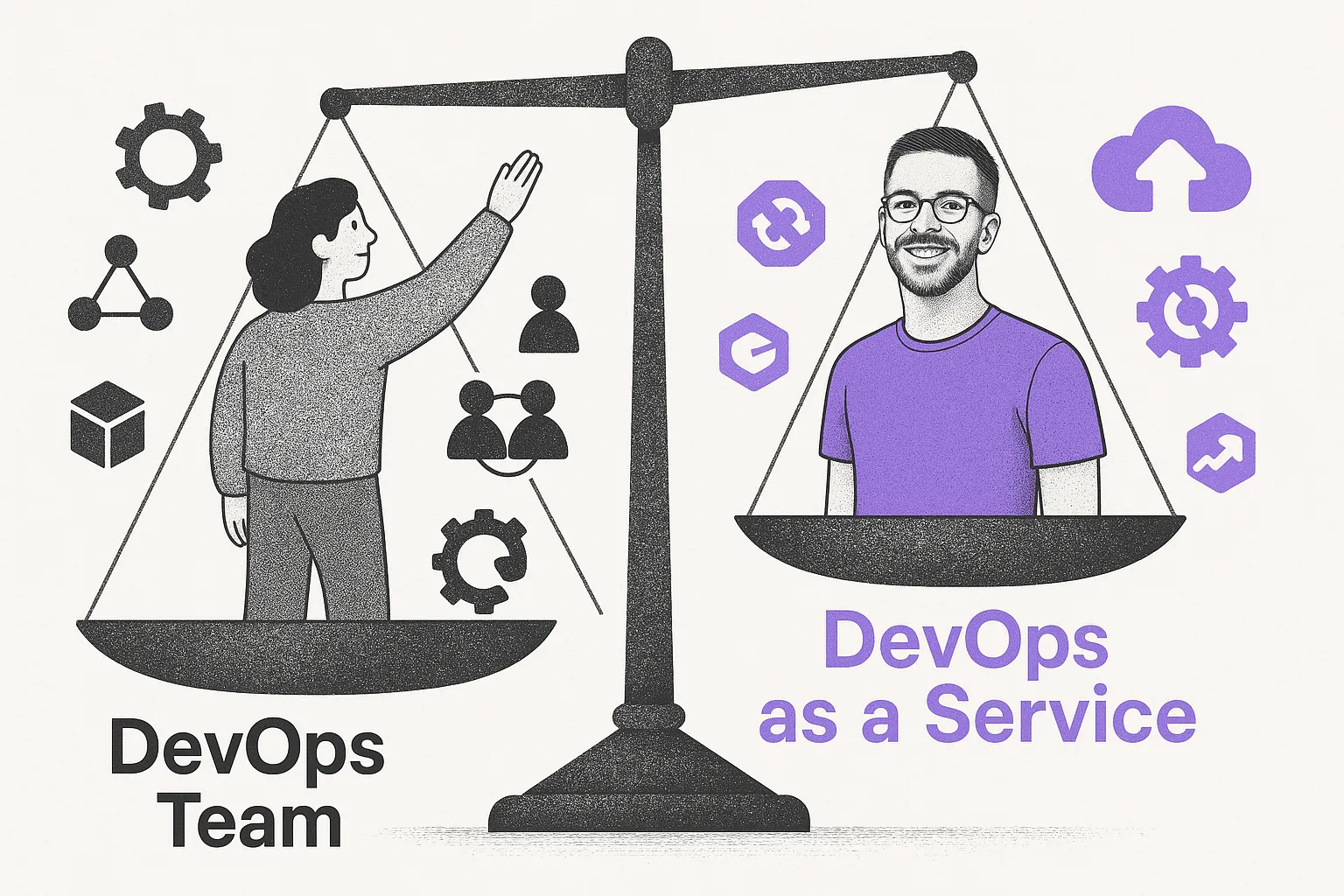
A DevOps team and DevOps as a Service solve different ownership problems. They can use similar tools, write similar Terraform, maintain similar pipelines, and respond to similar incidents. The difference is who owns the work, how close they are to product engineering, and how production responsibility is handled over time.
An internal DevOps team usually works best when DevOps needs are constant, product complexity is growing, and production knowledge must stay close to the business. DevOps as a Service usually works best when the company needs experienced execution, faster setup, temporary capacity, or a neutral review of current practices.
Neither model works if the rest of engineering treats DevOps as a ticket queue. Good DevOps operating models define:
- Ownership: who owns pipelines, cloud infrastructure, observability, incident response, and production standards.
- Decision rights: who can approve architecture changes, deployment patterns, access controls, and reliability tradeoffs.
- Service boundaries: what product teams can self-serve and what needs specialist support.
- Operational expectations: how teams measure deployment frequency, Mean Time To Recovery (MTTR), incident volume, lead time, cloud cost trends, and audit readiness.
- Knowledge sharing: how runbooks, diagrams, access procedures, and recovery steps stay current.
When an internal DevOps team makes sense
An internal DevOps team is a strong choice when DevOps work is continuous and closely tied to product direction. If your engineering teams deploy often, maintain several services, operate regulated workloads, or need deep context about architecture decisions, keeping the capability inside the company can pay off.
You should consider building an internal team when:
- Your product roadmap depends on infrastructure choices, deployment architecture, or reliability engineering.
- You need ongoing ownership of Infrastructure as Code (IaC), cloud networking, secrets, monitoring, and incident response.
- Your team has enough recurring work to justify dedicated headcount.
- You want production knowledge distributed across people who are involved in product planning.
- You need a long-term platform direction, such as standardized CI/CD, golden paths, or developer self-service.
The risk is that the team becomes a gatekeeper. If every deployment, environment change, or permission request waits on one DevOps person, the model slows delivery instead of improving it. A healthy internal team should reduce dependency over time by creating clear patterns, reliable automation, and usable documentation.
If you are deciding how to structure this capability, this guide on how to build a DevOps team covers the team design side in more detail.
When DevOps as a Service fits better
DevOps as a Service fits when you need senior DevOps execution without immediately hiring a full team. It can help when your current team is overloaded, your infrastructure is fragile, or you need production-grade practices before the business is ready for permanent DevOps headcount.
Common use cases include:
- Production setup: creating deployment pipelines, cloud environments, monitoring, alerting, backups, and access controls before a launch.
- Stabilization: reducing repeat incidents, cleaning up brittle CI/CD, improving rollback paths, and fixing gaps in observability.
- Cloud cost control: reviewing waste, rightsizing resources, improving tagging, and adding cost ownership to engineering workflows.
- IaC coverage: moving manually created infrastructure into Terraform or another IaC tool so changes are reviewable and repeatable.
- Audit readiness: preparing evidence for access controls, change management, backups, logging, and environment separation.
- Temporary capacity: covering a hiring gap, a migration, an incident backlog, or a short delivery window.
The main risk is treating DevOps as a Service as a way to outsource production ownership completely. A provider can build, fix, review, and operate parts of the system, but your company still needs clear internal ownership. Someone on your side must understand the tradeoffs, approve standards, and know how production works.
If you need to get a production setup reviewed before investing in a larger model, a DevOps setup consultation can help you identify the most urgent gaps. If the need is smaller or time-bound, a focused option such as a short DevOps support package may be enough to remove blockers without creating a long engagement.
Compare the models using operational signals
The better choice depends on operating signals, not preference. Look at how the current system behaves under normal delivery pressure and during incidents.
Deployment frequency
If deployments are rare because pipelines are unreliable, approvals are unclear, or release steps are manual, the issue may be operating model design. An internal team can build long-term standards. DevOps as a Service can help repair the pipeline, document the process, and create a cleaner release path.
MTTR and incident volume
If incidents repeat and recovery depends on one senior engineer, you have a resilience and knowledge-sharing problem. Track MTTR, incident count, repeat causes, alert quality, and runbook usage. A strong DevOps model should reduce avoidable incidents and make recovery less dependent on memory.
Cloud cost trends
Rising cloud spend is not always a DevOps failure, but unexplained spend usually points to weak ownership. Look for missing tags, oversized resources, unused environments, unclear cost alerts, and manual provisioning. Internal teams can own ongoing governance. A service provider can often help create the first cost-control baseline.
IaC coverage
If important infrastructure exists only in a cloud console, your team is exposed to drift, undocumented changes, and slow recovery. High IaC coverage makes infrastructure easier to review, reproduce, and audit. Low coverage is a strong signal that you need structured DevOps work, regardless of the model.
Audit readiness
If preparing for an audit means searching chats, screenshots, and old tickets, your process is too manual. Strong DevOps practices make evidence easier to collect because access, changes, backups, logs, and approvals are part of normal operations.
Developer lead time
If engineers wait days for environments, permissions, pipeline fixes, or deployment help, DevOps is slowing product delivery. The answer may be a platform approach, better self-service, clearer standards, or more specialist capacity.
Watch for failure modes in both choices
Both models can fail. The warning signs are usually visible before the situation becomes urgent.
Internal team failure modes
- The DevOps team becomes the default owner for every production problem, even when application teams should own the service.
- Work arrives through ad hoc messages instead of a clear intake process.
- Only one person understands cloud networking, CI/CD, secrets, or incident recovery.
- Developers cannot safely deploy without asking for manual help.
- Runbooks exist, but nobody uses or updates them during real incidents.
DevOps as a Service failure modes
- The provider fixes issues, but the internal team does not learn how the system works.
- Ownership is vague, especially for incidents and production approvals.
- Work focuses on tools before operational goals are clear.
- Documentation is delivered at the end instead of maintained during the work.
- The engagement ends without a handover plan, runbooks, or a clear backlog.
A good service arrangement should leave your team stronger. You should gain cleaner infrastructure, clearer runbooks, better visibility, and fewer single-person dependencies.
Use a simple decision path
If you are deciding between an internal team and DevOps as a Service, use a practical sequence.
- List the real problems. Avoid starting with headcount. Write down the top issues: slow deployments, repeat incidents, cloud cost growth, audit gaps, weak IaC coverage, poor runbooks, or production knowledge concentrated in one person.
- Measure what you can. Track deployment frequency, MTTR, incident volume, developer lead time, cloud cost trends, and how much infrastructure is managed through IaC.
- Separate urgent fixes from permanent ownership. Some work needs immediate attention. Other work needs a long-term team model.
- Decide what must stay internal. Production decision-making, product context, and business risk ownership usually need internal accountability.
- Decide where outside help can move faster. Setup, review, stabilization, migration, documentation, and backlog cleanup are often good candidates.
- Plan the handover before the work starts. Define runbooks, diagrams, access rules, incident procedures, and acceptance criteria early.
If you are unsure where the biggest gaps are, a structured DevOps audit can give you a clearer view before you commit to a hiring plan or a service engagement.
Takeaway
Choose an internal DevOps team when you need continuous ownership close to product engineering. Choose DevOps as a Service when you need experienced execution, faster setup, stabilization, or outside review. Use both when you need immediate progress while building long-term capability.
The right model should improve deployment speed, recovery, cloud control, audit readiness, and production confidence. If the model creates more handoffs, more waiting, or more hidden knowledge, redesign it before adding more tools or people.